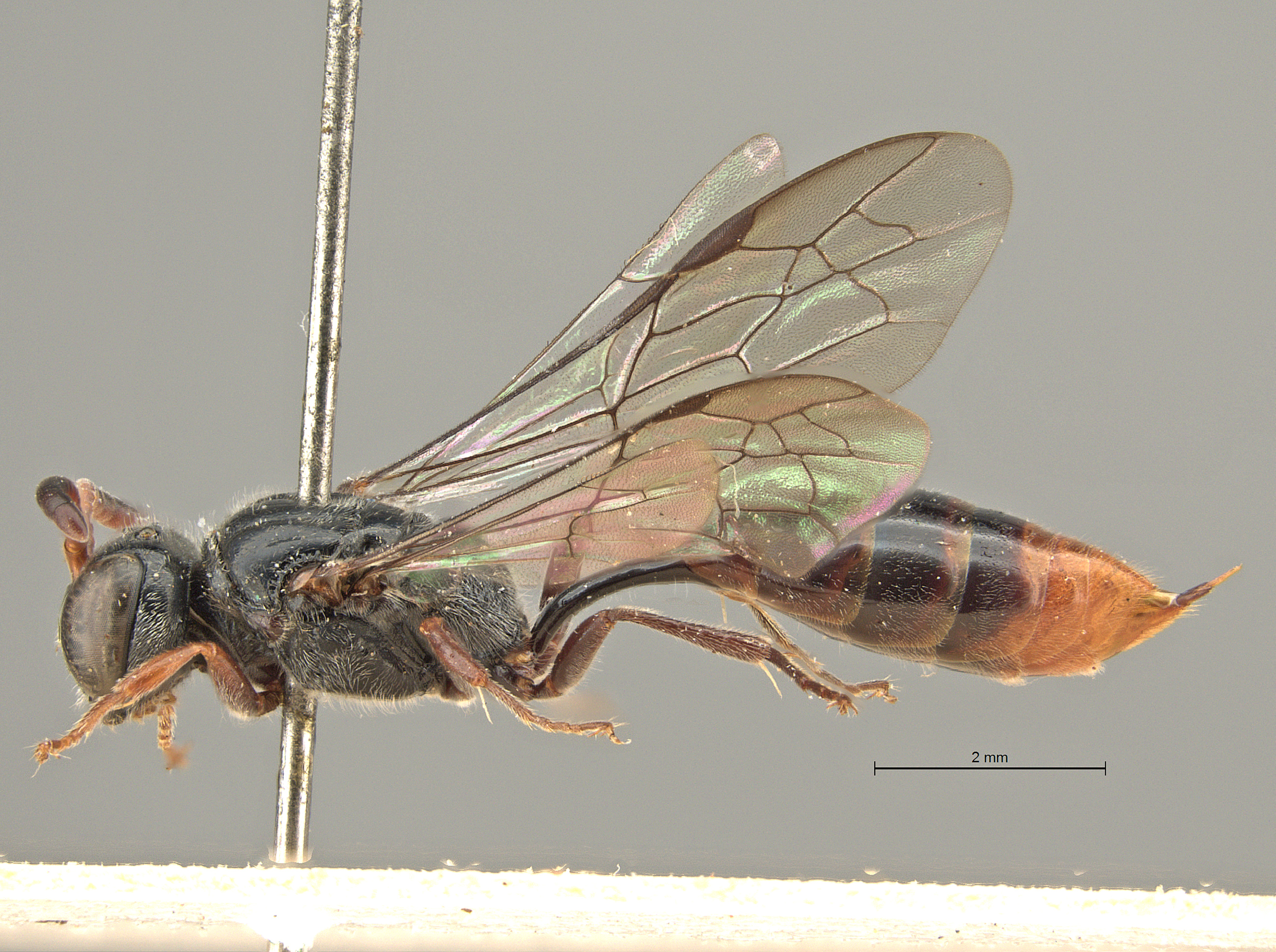
Family Psenidae A. Costa, 1858
-
Genus Mimesa Shuckard, 1837
-
Genus Psen Latreille, 1796
-
Psen congolus Leclercq,
1961 (Democratic Republic of Congo)
-
Psen leclercqi van Lith,
1974 (Madagascar)
-
Psen patellatus Arnold,.
1924 (Namibia)
-
Psen silvaticus Arnold,
1924 (Zimbabwe)
-
Genus Pseneo Malloch, 1933
-
Genus Psenulus Kohl, 1897
-
Psenulus alboscutellatus Arnold, 1945 (Madagascar)
-
Psenulus alveolatus van
Lith, 1974 (Zimbabwe)
-
Psenulus avernus Leclercq, 1961 (Democratic Republic of Congo)
-
Psenulus benoiti Leclercq, 1961 (Democratic Republic of Congo)
-
Pseunulus bidentatus Cameron, 1908 (Kenya, Tanzania, Democratic Republic of
Congo)
-
Psenulus bidentatus pallidus van Lith, 1974 (Democratic Republic of Congo)
-
Psenulus bidentatus
rubrocaudatus Turner, 1912 (South Africa)
-
Psenulus capensis Brauns,
1899 (Ethiopia, Mozambique, South Africa)
-
Psenulus dilectus (de
Saussure, 1892) (Madagascar)
-
Psenulus ealae Leclercq,
1961 (Democratic Republic of Congo)
-
Psenulus erusus Leclercq,
1961 (Democratic Republic of Congo)
-
Psenulus fulgidus Arnold,
1945 (Madagascar)
-
Psenulus garambae Leclercq, 1961 (Democratic Republic of Congo)
-
Psenulus ghesquierei Leclercq, 1961 (Democratic Republic of Congo)
-
Psenulus jacoti van Lith,
1974 (South Africa)
-
Psenulus kohli Arnold,
1923 (Zimbabwe)
-
Psenulus latiannulatus (Cameron, 1908) (Kenya)
-
Psenulus latiannulatus
basilewskyi Leclercq, 1955 (Rwanda)
-
Psenulus luctuosus Arnold, 1929 (Zimbabwe)
-
Psenulus lusingae Leclercq, 1961 (Democratic Republic of Congo)
-
Psenulus patei Arnold,
1940 (Zimbabwe)
-
Psenulus paulisae Leclercq, 1961 (Democratic Republic of Congo)
-
Psenulus reticulosus Arnold, 1945 (Madagascar)
-
Psenulus rugifrons van
Lith, 1974 (Ethiopia)
-
Psenulus saltitans Arnold, 1958 (Zimbabwe)
-
Psenulus stevensoni Arnold, 1940 (Zimbabwe)
-
Psenulus trevirus Leclercq, 1961 (Democratic Republic of Congo)
-
Psenulus turneri Arnold,
1927 (South Africa)
|
References |
Aguiar AP, Deans AR, Engel MS, Forshage M, Huber JT, Jennings JT, Johnson NF,
Lelej AS, Longino JT, Lohrmann V, Miko I. 2013. Order Hymenoptera. In: Zhang, Z.-Q.(Ed.) Animal Biodiversity: An Outline
of Higher-level Classification and Survey of Taxonomic Richness (Addenda 2013). Zootaxa 3703: 51-62. http://dx.doi.org/10.11646/zootaxa.3703.1.12
Branstetter MG,
Danforth BN, Pitts JP, Faircloth BC, Ward PS, Buffington ML, Gates MW, Kula RR,
Brady SG. 2017.
Phylogenomic insights into the evolution of stinging wasps and the origins of
ants and bees. Current Biology 27: 1019-1025. https://doi.org/10.1016/j.cub.2017.03.027
Branstetter MG, Childers AK, Cox-Foster D, Hopper KR, Kapheim KM, Toth AL,
Worley KC. 2018. Genomes of the Hymenoptera. Current Opinion in Insect Science 25:
65-75. https://doi.org/10.1016/j.cois.2017.11.008
Brothers D.J.
1999. Phylogeny and evolution of wasps, ants
and bees (Hymenoptera, Chrysidoidea, Vespoidea and Apoidea) Zoologica
Scripta 28: 233–250.
Debevec AH, Cardinal S, Danforth BN. 2012. Identifying the sister group to the bees: a molecular phylogeny of Aculeata with
an emphasis on the superfamily Apoidea. Zoologica scripta 41: 527-35. https://doi.org/10.1111/j.1463-6409.2012.00549.x
Eardley, C, Finnamore, A.T. & Michener, C.D. 1993. Superfamily Apoidea (pp.
279-357). In GOULET, H. & HUBER, J. (eds). Hymenoptera of the World:
an identification guide to families. Research Branch, Agriculture
Canada, Ottawa, Canada, 668 pp.
Gess, S.K. & Gess, F.W. 2014. Wasps and bees in southern Africa. SANBI
Biodiversity Series 24. South African National Biodiversity Institute,
Pretoria. 320 pp.
Johnson BR, Borowiec ML, Chiu JC, Lee EK, Atallah J, Ward
PS. 2013. Phylogenomics resolves evolutionary relationships among ants, bees, and wasps. Current Biology 23: 2058–2062. https://doi.org/10.1016/j.cub.2013.08.050
Ohl, M. & Bleidorn, C. 2006. The phylogenetic position of the enigmatic wasp family Heterogynaidae
based on molecular data, with description of a new, nocturnal species
(Hymenoptera: Apoidea). Systematic Entomology 31: 321–337.
doi: 10.1111/j.1365-3113.2005.00313.x
Peters RS, Krogmann L, Mayer C,
Donath A, Gunkel S, Meusemann K, Kozlov A, Podsiadlowski L, Petersen M,
Lanfear R, Diez PA. 2017. Evolutionary history of the Hymenoptera. Current Biology 27:1013-1018. https://doi.org/10.1016/j.cub.2017.01.027
Pilgrim EM, von Dohlen CD, Pitts JP. 2008. Molecular phylogenetics of Vespoidea indicate paraphyly of the superfamily and
novel relationships of its component families and subfamilies. Zoologica
Scripta 37: 539–560. https://doi.org/10.1111/j.1463-6409.2008.00340.x
Sann M, Niehuis O, Peters R, Mayer C, Kozlov A,
Podsiadlowski L, Bank S, Meusemann K, Misof B, Bleidorn C, Ohl M. 2018.
Phylogenomic analysis of Apoidea sheds new light on the sister group of bees. BMC Evolutionary Biology 18: 71. http://dx.doi.org/10.1186/s12862-018-1155-8
Sann, M., Meusemann, K., Niehuis, O., Escalona, H.E., Mokrousov, M., Ohl, M., Paul, T. & Schmid-Egger, C. (2021) Reanalysis of the apoid wasp phylogeny with additional taxa and sequence data confirms the placement of Ammoplanidae as sister to bees. Systematic Entomology 46 (3), 558–569. https://doi.org/10.1111/syen.12475
Sharkey, M., 2007. Phylogeny and classification of
Hymenoptera. Zootaxa 1668: 521–548.
Sharkey, M.J., Carpenter, J.M., Vilhelmsen, L., Heraty, J.,
Liljeblad, J., Dowling, A.P.G., Schulmeister, S., Murray, D., Deans, A.R., Ronquist, F., Krogmann, L. and Wheeler, W.C. 2012. Phylogenetic relationships among superfamilies of Hymenoptera. Cladistics 28: 80–112. doi: 10.1111/j.1096-0031.2011.00366.x |
Links
|
CATALOG OF WORLD SPHECIDAE
sensu lato (= Apoidea excluding bees) compiled by
Wojciech J. Pulawski (California Academy of Sciences). |
Credits
|
Photograph © Iziko Museums of South Africa. |
|