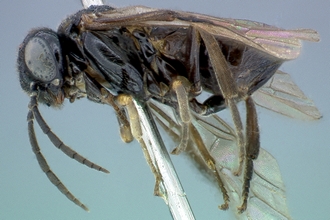
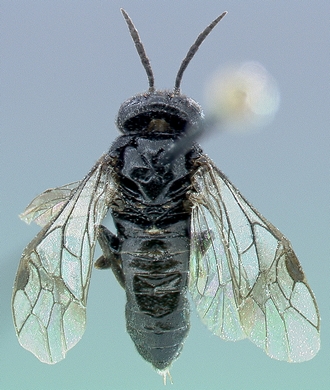
|
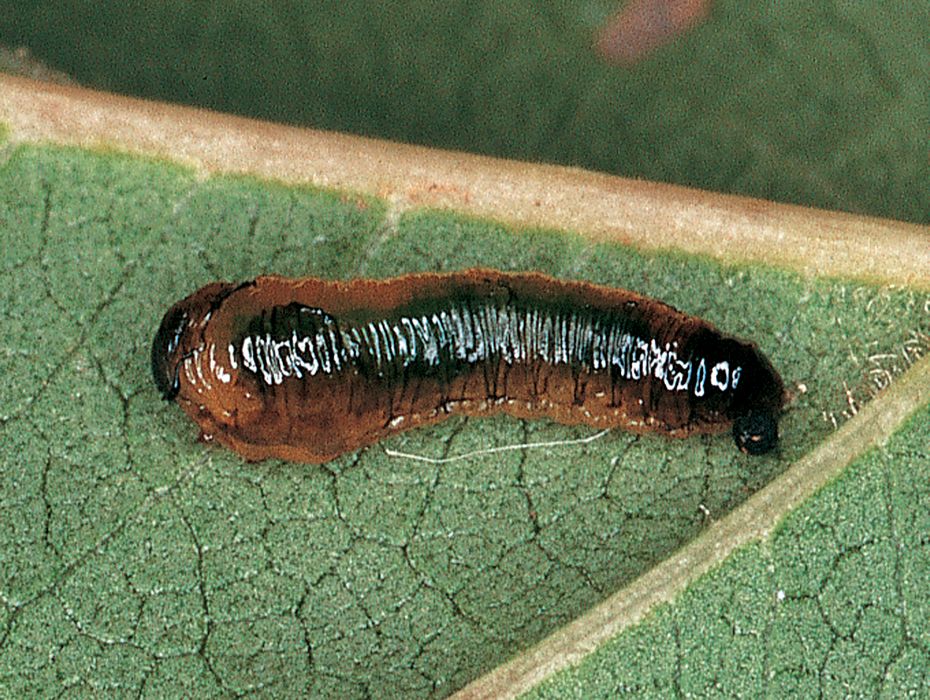
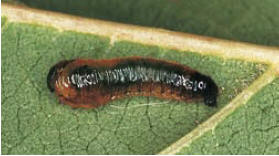
Slug-like
larvae of the Pear Slug. Photograph
© Charles Griffiths. |
Distribution
|
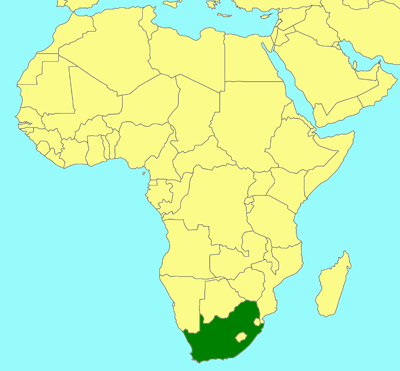
Introduced to South Africa. Widespread in the Palaearctic
Region, and has been introduced into North America, Argentina, Chile,
Uruguay, Australia (including Tasmania), New Zealand (Smith, 1971) and
South Africa. In South Africa C. cerasi is reported from the
following provinces: Eastern Cape, Free State, Gauteng, KwaZulu-Natal,
North West, Western Cape (Koch & Smith, 2011; Koch et al., in press). A
global distribution map is available in van Noort & Picker (2011).
|
Biology |
Phytophagous.
Larvae feed on leaves of Rosaceae, especially cultivated Pyrus
(Pears) and Prunus (Plums), also cherries and apples. Larvae
resemble small slugs (greenish-brown with a large head-end tapering to
the tail), cover themselves with slime as a protection against
predation, and feed on epidermis of leaves, in the process skeletonising
them, and pupate in the soil beneath host plant. Adult wasps emerge,
mate, and female uses her saw-like ovipositor to lay eggs in leaves.
Impacts: Pest of fruit industry, damaging leaves of cherry, plum,
pear and apple trees. Heavy infestations reduce fruit yield. Control:
Manual tillage of soil beneath fruit trees to kill cocoons.
Insecticide application. In South Africa C. cerasi is known as a
pest on deciduous fruit trees such as peach, quince, apricot and plum (Prinsloo,
1985; Prinsloo & Uys, 2015). |
Ecology
|
The males of this species are very rare in the Palaearctic
Region, except in parts of the Mediterranean Region, and unknown in
southern Africa, where Caliroa cerasi appears to be
parthenogenetic (Koch et al., 2015). The flight season in South Africa
is from September to April and July (Koch et al., 2015). |
References |
Goulet,
H. 1993. Superfamilies Cephoidea, Megalodontoidea, Orussoidea,
Siricoidea, Tenthredinoidea and
Xyeloidea (pp.
101-129). In GOULET, H. & HUBER, J. (eds). Hymenoptera of the World:
an identification guide to families. Research Branch, Agriculture
Canada, Ottawa, Canada, 668 pp.
Kaiser, C. & Sheard, A.G. 2001. Integrated pest
and disease management (IPDM) of apples and pears in KwaZulu-Natal.
KZN Agri Report No. NA-2001-06.
Koch, F. & Smith, D.R. 2011. A new species of
Caliroa (Hymenoptera:
Tenthredinidae) from South Africa. Proceedings of the Entomological
Society of Washington, Washington 113 (4): 442-450.
Koch F, Goergen G & van Noort S. 2015. The sawflies of Namibia and the western parts
of South Africa (Symphyta, Hymenoptera). ABC Taxa 15: 1-262.
Picker,
M., Griffiths, C & Weaving, A. 2002. Field Guide to Insects of South
Africa. Struik Publishers, Cape Town.
Prinsloo, G.L. 1985. Suborder
Symphyta. In: Scholtz, C.H. & Holm, E. (Eds). Insects of Southern
Africa. Butterworth, Durban: 395-399.
Taeger, A., Blank, S.M. & Liston,
A.D. 2010.
World Catalog of Symphyta (Hymenoptera). Zootaxa 2580:
1-1064.
van
Noort, S. & Picker, M.
2011.
Wasps, Bees, Ants. Class Insecta, Order Hymenoptera.
Pp 140-146. In:
Picker,
M. & Griffiths, C. (eds.)
Alien & Invasive Animals. A South African perspective.
Struik Nature.
|
Credits
|
Photographs © Andrew D. Liston (Senckenberg Deutsches Entomologisches Institut),
or © Charles Griffiths (University of
Cape Town) (published
in Struik's
Field Guide to Insects of South Africa).
|
|